
Mechanicalmetal finishing
Classic design variants.
Turning or milling of the metals is also possible. Due to the automated, robot-controlled treatment of the surfaces, every processing is 100 % reproducible.


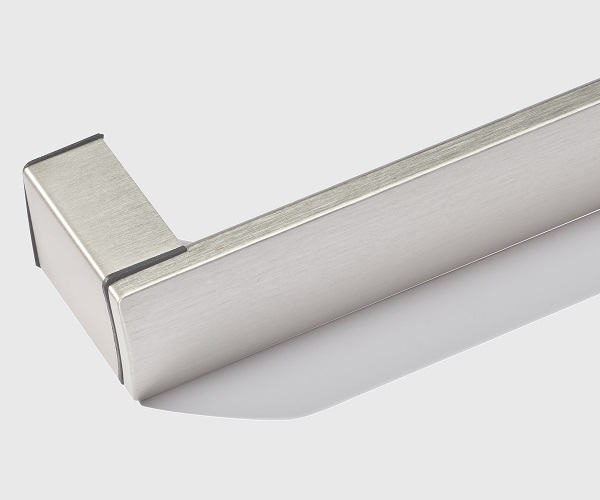


Methods in manufacturing.
- Brushing and grinding
- Blasting
- Polishing
- Subsequent methods of refinement

In these machining processes, the material is removed manually or mechanically using appropriate abrasives and rubbing motions to achieve the desired surface structure.
Particularly during the brushing of metal or aluminium, fine-, medium- or coarse-textured surfaces can be produced for high-quality optics and further refined in a subsequent process, e.g. anodising.
According to DIN 17611:
– Without pre-treatment E0
– Grinded E1
– Brushed E2
– Polished E3
– Grinded and brushed E4
– Grinded and polished E5
– Special stained E6
– Chemically polished E7
– Polished and chemically polished E8
In blasting, the surface treatment is carried out using different blasting media that are directed onto the material at high speed, e.g. by means of air. This densifies the material and at the same time strengthens the surface. This process can also be used to clean, chip, matt and finish surfaces, among other things.
According to DIN 17611:
– Blasted E9
Possible structures:
– Fine blasting pattern S10
– Medium blasting pattern S11
– Coarse blasting pattern S12
We achieve high gloss levels through the process of laser polishing.
By removing thin layers of the surface, the smallest burrs, particles, irregularities and impurities are removed. This makes it possible to achieve high strength and lower adhesion as well as the pure and shiny results for the material.
According to DIN 17611:
– Polished E3
– Grinded and polished E5
– Polished and chemically/electrolytically polished E8
Anodising
We have a factory-owned anodising plant that can support you with the following finishing processes:
- Organic or electrolytic anodisation
- Partial / selective anodising
- Anodising of already back-moulded components
In addition, various forms of pre- and post-treatment are possible, for example brushing, grinding, blasting, polishing, special pickling and lasering.
Powder coating
Using our own powder coating facility, we coat components with a choice of over 210 RAL colours, which we deliver just-in-time. For special requirements, we provide the surfaces for example with anti-stick or anti-fingerprint coatings.
Laser, etching and printing
For the visual labelling of functional components and other products, e.g. with logos, symbols or lettering, we use various processes for individual decorative and functional coatings:
- Etching technologies
- Screen and pad printing
- Laser marking, laser engraving
Advantages in surface finishing.
Resistance
Customisation
Hybrid
Variety
Integration ability
Cleaning
Food-grade easy-to-clean surfaces.
Cross-functional performance spectrum.
In addition, we fulfil the entire service supply chain – from toolmaking and metalworking to back injection with plastics, final assembly and logistics – all from a single source.
back injection moulding with plastics to final assembly and logistics – all from a single source.
- Mechanical processing
- Hybrid composites & bonding
- Injection moulding
- Toolmaking & assembly
Series production of moulded parts
Aluminium, sheet metal, stainless steel and steel:
- Bending and forming
- Turning (CNC), milling (CNC), sawing
- Punching and pressing with up to 500 t
- Grinding and polishing
- Welding
Back-injection of metal and metal foils
For the required substructure of metal components and metal foils, we back-inject them with the required plastics.
We design and manufacture the plastic injection moulding tools required for this ourselves in order to avoid distortion due to shrinkage and different linear expansions. Furthermore, we integrate the desired electronics or lighting elements during back injection moulding.
Joining and bonding technologies
We join components using a wide variety of methods. In bonding, we use liquid adhesives, adhesive tapes and also adhesive die-cuts, which we apply manually or robotically. Optionally, different types of pre-treatment are possible, including plasma, primer, scarfing or pyrosil as well as different rapid curing methods (UV light, infrared, heat radiation).
- 1C adhesives with manual and robot-assisted application
- 2C adhesives in robot systems with high-end dispensing technology
- Adhesive tapes with manual or robot-assisted application
- Punched adhesive substrates with special systems for perfect positioning and pressing
Plastic injection moulding
We manufacture a wide range of different products, including fan wheels and components as part of assemblies, in our own plastic injection moulding shop with machines up to 300 t clamping force.
We manufacture the corresponding moulds and injection moulding tools ourselves.
Toolmaking
- Embossing tools
- Punching tools
- Multi-cavity tools
- Progressive dies
- Injection moulds
- Transfer tools
- Forming tools for visible components
- Devices for handling
- Testing and measuring devices
Assembly and automation
- Manual assembly
- Partially automated assembly of small to medium quantities
- Fully automated production of large quantities
- Complete assembly lines incl. safety and function tests
- Customised assembly lines